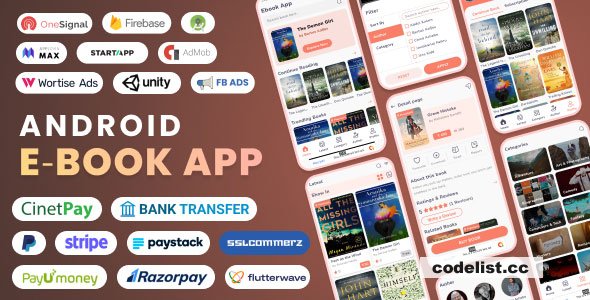
Android EBook App (Books App, PDF, ePub, Online Book Reading, Download Books) v21.0 - nulled
Latest UI with material design Rent book and subscription plan Payment gateways (PayPal, Stripe, Razorpay, Paystack, PayUMoney, Flutterwave) Home section dynamic Download button enable disable Filter wise search Author wise book listing
What is Android Ebook App with Material Design?
This is a ready-made Android application template (sold on platforms like CodeCanyon) that offers:
-
A fully-functional Android app for e-books: reading, browsing, categorising books (PDF, ePub or whichever formats supported) with a Material Design UI. CodeCanyon+1
-
Likely features such as book library, reading settings (fonts, themes, day/night mode), categories/genres, favorite/bookmark, search. (While the full spec may vary, similar templates list these.) CodeCanyon+1
-
Possibly an admin panel or back-end (depending on version) to manage book uploads, categories, users; though you’ll need to check the exact package you purchase.
-
Built with Material Design aesthetic (Google’s design guidelines) so the UI looks modern and works well on Android devices.
In short: If you want to launch an e-book reading/distribution app on Android without building everything from the ground‐up, this template gives you a strong foundation.
Why this matters (and what makes it high-value)
1. Mobile reading is growing
With smartphones becoming ubiquitous globally (including India and your location in West Bengal), more users are reading books, PDFs, magazines on mobile devices. A native Android app that enables reading + library management meets that trend.
2. Reduced development overhead
Instead of building an Android app from scratch (UI + reading engine + library + management + aesthetics), you get a template. This saves time, cost, and allows you to focus on content, brand, and monetisation.
3. Modern UI (Material Design)
Using Material Design means your app will look contemporary, provide good UX, and fit Android user expectations—which helps in retention and reviews.
4. Customisable & scalable
Because it’s a codebase, you can customise features: add your own payment gateway, add offline reading, add new formats, integrate with your own backend, monetise with subscriptions/ads – as you choose.
5. Opportunity for niche focus
You could focus on a niche (regional language e-books, academic textbooks, exam prep, children’s picture books) and differentiate, rather than compete with giant reading apps. A template lets you go to market fast.
Key Features – in depth
Based on what similar templates in the “eBook Android App with Material Design” category list, the likely core features (and their value) are:
FeatureValue to youLibrary / Book list & categoriesLets users browse a catalog of books (genre, language, etc) → you organise your content.Reading view (PDF/ePub) with settings (fonts, size, background, day/night)Improves usability: reading comfort, longer sessions, better retention.Favorites, bookmarks, historyHelps users pick up where they left off; promotes engagement.Search/filter booksGood UX for discovering books – critical if your catalog grows.Offline download (if supported)Key in regions with intermittent connectivity (e.g., many users in India).Material Design UISmooth, modern, aligns with Android design norms → better user perception.Admin panel / content management (if included)Lets you update books, manage users or content without rebuilding the app.Monetisation options (ads, in-app purchases/subscriptions)Lets you build revenue from your app – important for business viability.
How this fits you (especially given your existing work)
From your context, you are:
-
Experienced building Android apps (you mentioned building an Android tool app and other mobile development).
-
Comfortable with backend/admin panel logic (you’ve built Node.js/MongoDB admin dashboards).
-
Interested in user-facing apps with good UI/UX, and you have some design awareness.
Here’s how this e-book app template could align with your skills & business goals:
-
Leverage your Android skills: You already have Android Studio/Java (or maybe Kotlin) experience. So customising this template will be well within your capabilities.
-
Use your backend experience: If the template has an admin panel (or if you add your own), you can integrate content management, user authentication, analytics – using your familiar Node/Mongo or Laravel backend stack.
-
New product vertical: You have built many utility/style apps; launching an e-book app gives you a new vertical (education, reading) which may tap a different monetisation or user base.
-
Regional targeting: Since you are in Howrah/West Bengal, you can localise the app into Bengali, target local students, exam books, region-specific content. This niche focus can be a strong differentiator.
-
Monetisation strategy: You know how to build apps with admin and transaction logic; you can integrate subscriptions, paid books, freemium content, local payment gateways (Razorpay etc) and capture revenue from your local market.
Implementation considerations & best practices
If you decide to use this template (or similar), here are things to keep in mind for best results:
Pre-Purchase / Evaluation
-
Check exactly which formats are supported (PDF, ePub, other).
-
Check whether offline download is included (important for offline reading).
-
Verify if a back-end/admin panel is included and what tech stack it uses (PHP, Node, Firebase).
-
Review documentation & update frequency (Android OS changes quickly; you want a codebase that is maintained).
-
Check licensing terms: for commercial use you’ll need a licence that covers your distribution model.
Customisation & Branding
-
Re-brand: change app icon, splash screen, colour theme to match your brand.
-
Localisation: Add languages relevant to your audience (Bengali, Hindi + English).
-
Custom categories: Let users filter by exam type, language, grade, etc – this helps marketing.
-
Payment integration: If you plan paid books/subscription, integrate local payment gateways (Razorpay, PayU India) and ensure currency support.
-
Analytics: Integrate Firebase Analytics / Google Analytics to track user behaviour (reading time, most popular books, drop-off) and improve engagement.
Technical Setup & Deployment
-
Hosting/back-end: make sure server or Firebase supports your expected user-base.
-
App performance: Reading apps often handle large files; test performance (load time, memory usage) especially on lower-end devices (common in Indian market).
-
UX readiness: Reading mode must support day/night, font size, safe margins, smooth paging.
-
Content management: Create a pipeline for uploading new books, managing metadata (title, author, category, thumbnail) in the admin panel.
-
DRM / copyright compliance: If you’re distributing paid books, ensure you have rights and respect copyright laws.
-
Store listing & marketing: Create a Google Play Store listing with a compelling description, screenshots, videos of reading experience.
Growth & Engagement Strategies
-
Freemium content: Offer some free books to attract users, then premium/paid ones.
-
Subscription model: Provide access to full library for a monthly fee.
-
Community/reading clubs: Add features like “Reading list”, “Share book/quote”, “Recommendations” to increase engagement.
-
Push notifications: Remind users about new books, reading progress, recommendations.
-
Partnerships: Collaborate with local authors, exam prep publishers to populate content relevant to your region.
-
Analytics + iteration: Track metrics like daily active users, average session length, retention after 7/30 days, book completion rate; iterate accordingly.
Avoiding Pitfalls
-
Don’t assume template is “zero work”: You will still need to customise, add content, test, market.
-
Device fragmentation: Android ecosystem is wide – ensure your app works well on older devices, screen sizes.
-
Content supply: The app is only as good as the content – you need a steady stream of books/quality material.
-
Discoverability: With many e-book apps out there, you need a strong differentiation (language, local focus, unique content) and marketing plan.
-
Monetisation mismatch: If you ask too much for paid content without enough value/trust, users may turn away. Start with good freebies, build trust.
Use-Case Example for India / West Bengal
Here’s how you might launch “Howrah Readers” – a localised e-book reading app targeted at students and readers in West Bengal/India.
Steps you might follow:
-
Acquire the Android Ebook App template and deploy a test version.
-
Customise branding: name it “Howrah Readers”, local colour palette, app icon.
-
Localise UI: Add Bengali and English language options; translate key strings.
-
Content focus: Upload exam-prep books for board exams (HS, Madhyamik), local history & culture, Bengali literature, children’s storybooks.
-
Monetisation: Offer free book library + premium “Exam Prep Pack” at ₹199/month with new books each month.
-
Payment: Integrate Razorpay/UPI for premium purchase; also add ads for free users.
-
Engagement: Offer “Book of the Day”, “Top reads in your city”, “Reading challenge” (read 5 books this month, get reward).
-
Marketing: Partner with local schools, libraries, reading clubs in Kolkata/Howrah; run social media campaigns; run offline QR codes in cafés/colleges.
-
Analytics: Track which books are being read most, which categories have high drop-off; refine content schedule.
-
Scale: After initial success, add Hindi content, include audiobooks, support Android TV, maybe iOS later.
With your background (Android + backend), you could handle the customisation yourself (or with minimal help), focus your time on content acquisition, localisation, marketing.
Final Thoughts & Recommendation
If you are serious about launching an e-book reading/distribution app (especially for a regional market like you are positioned in) then this template is a very strong starting point. It gives you infrastructure you’d otherwise spend weeks/months building. And given your skillset, you’re well positioned to customise & expand it.
Here are my final recommendations:
-
Buy the licensed version from CodeCanyon so you have full support and updates.
-
Initial MVP: Launch with a smaller content library (~50-100 books), strong branding, a “free” tier + one premium pack.
-
Focus on marketing & content: The technology side will be handled by the template/customisation; your key differentiators will be content, localisation, UX and promotion.
-
Measurement & iteration: Track key metrics (install → registration → first book read → retention after 7 days → subscription conversion) and iterate to improve.
-
Plan for growth: Have roadmap to add more features (offline reading, audiobooks, reading clubs, social share) once base version is running.
Demo:
https://codecanyon.net/item/android-ebook-app-with-material-design/21680614https://workupload.com/file/T3qSkQLzjm6
https://www.upload.ee/files/18650643/androidebook-21nulled.rar.html
https://pixeldrain.com/u/V8zgjB5u
https://www.mirrored.to/files/1ZXWLIPN/androidebook-21nulled.rar_links
https://krakenfiles.com/view/qTP98wjneE/file.html
https://katfile.cloud/9jlbhunwc6uw
https://ddownload.com/o9345yqphw7l
https://bowfile.com/2NE93
https://1fichier.com/?1iz3mlhkwamvqy6kfkvd
https://1cloudfile.com/4bD6d
This file has been NULLED - (license requirements have been removed)