


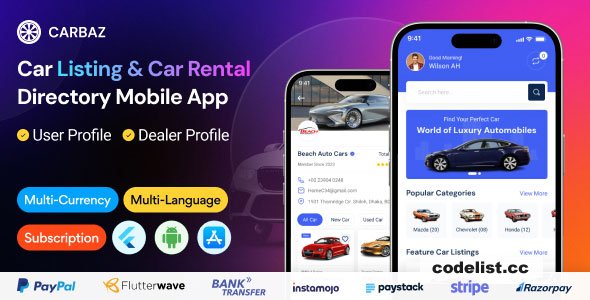
Carbaz is a strong starting point for anyone wanting to build a car listing + rental mobile app. It gives you the UI, cross-platform advantage, and core workflows all set up. The real value is in how you customise it to your local market and business model: payment methods, localisation, regulatory flows, unique features, and differentiation.
If you’re looking to build or launch a mobile-app driven car listing and rental marketplace, Carbaz is a solution worth considering. Built using Flutter, the “Carbaz – Car Listing & Car Rental Directory” app template offers a ready-made platform for both car owners (listing vehicles) and renters (booking vehicles). Here’s a full breakdown of what it offers, the pros & cons, and how you might use it — especially if you're building something similar in India or elsewhere.
Essentially, Carbaz is a mobile app template and backend system that provides:
A listing directory of cars available for rent (owners list their vehicles)
A rental booking workflow (renters find, book, pay)
Admin/management screens to oversee listings, users and transactions
Cross-platform (iOS & Android) via Flutter, meaning one codebase for both platforms. CodeCanyon+2CodeCan+2
Modern UI, many pre-built screens (~40+). CodeCanyon
In short: if you want to launch a car-rental marketplace or a directory app (or combine both), Carbaz gives you the skeleton — saving you from building from scratch.
Here are some of the standout features the listing says Carbaz offers:
40+ high-quality screens: Meaning you get a rich UI ready-to-go. CodeCanyon+1
Modern design that works across devices (thanks to Flutter). CodeCanyon
Listing management: Car owners can add/edit/remove cars; renters can browse listings, filter by model/price/location etc.
Directory + rental workflow: So it isn't just a catalogue of cars — it supports booking/rental features too.
Customizable: You can tweak UI, features, branding to suit your region or business model.
Cross-platform: Deploys on Android & iOS without two separate native codebases.
Admin panel/back-end: Manage listings, users, analytics, transactions.
(In some versions) Real-time updates and algorithmic recommendations. CodeCan
If you’re operating in India (or a similar market) and thinking of a car-rental or car-listing marketplace, this kind of template offers benefits:
Faster time to market: Instead of building from zero, you get a scaffold already done.
Cost-efficient: Templates like this typically cost far less than full custom development.
Flexibility: You can adapt UI/UX and workflows to local market needs (e.g., payment gateways, regional languages, local vehicle types).
Proven structure: Since it provides listing + rental + admin flows, you’re not reinventing core functionality.
Cross-platform: Important in many markets where both Android & iOS matter.
No template is perfect — and depending on your exact needs, you’ll want to verify and possibly customise further:
Localization & Payment Gateways: Ensure the app supports Indian payment methods (UPI, wallets, etc), and language localisation (e.g., Hindi/Bengali) if needed.
Vehicle & rental rules: In Indian context, you’ll likely need to handle vehicle ownership rules, driver options (self-drive vs chauffeur), insurance, deposits — check how much the template supports vs how much you’ll need to build.
Compliance / Regional Adaptation: Regulations differ (vehicle rental laws, tax, permits) — you may need to build in those regulatory flows.
Backend scalability & performance: If you plan to scale, the template’s backend must be robust or customisable/upgradable.
UI / UX suitability for your target audience: The template may be generic; you’ll want to adapt visuals, flows to your local market’s habits and preferences.
Updates & support: Since this is a purchased template, check how well the developer updates it, supports bugs, adds new features.
Differentiation: If you launch in a competitive market, you’ll want to think about how you differentiate (fleet management, driver scheduling, subscription models, integration with local services etc) — the template gives you the base, but you’ll likely need custom features to stand out.
Here are a few scenario ideas:
City-specific rental marketplace
Target a tourist or business-heavy city in India (e.g., Kolkata, Mumbai, Delhi).
Onboard local car owners/fleet owners to list vehicles (compact, sedan, SUV).
Renters browse by area, date/time, vehicle type, price.
Use localisation: Indian rupee currency, local payment gateways, local language, local pickup/drop zones.
Add features like chauffeur option, fuel inclusion, parking pickup, mileage limits, etc.
Peer-to-peer car sharing
Car owners list cars when not in use; renters book for short durations (hours/days).
Use template’s listing + booking workflow, and build in driver verification, insurance coverage, KYC.
Build trust via reviews/ratings. The template mentions reviews & ratings support. Codekanor+1
Fleet rental + B2B bookings
For corporate clients needing vehicles for events/travel.
Add extra admin features (bulk booking, corporate dashboards).
Use template as base for listing vehicles, managing bookings, payments.
Carbaz is a strong starting point for anyone wanting to build a car listing + rental mobile app. It gives you the UI, cross-platform advantage, and core workflows all set up. The real value is in how you customise it to your local market and business model: payment methods, localisation, regulatory flows, unique features, and differentiation.
If you’re serious about launching such a platform, the next steps would be:
Purchase the template, run it in dev mode, explore all screens and backend.
Map your market’s needs (vehicle types, rental durations, drivers vs self-drive, deposit/fuel rules, payment flows).
Adapt UI/UX & language/currency.
Add missing features (KYC, insurance, driver scheduling if needed).
Test thoroughly (booking flows, payment, listings, mobile UI).
Launch an MVP in your city, collect feedback, iterate.
Demo: https://codecanyon.net/item/carbaz-car-listing-car-rental-directory-flutter-app/56728923