


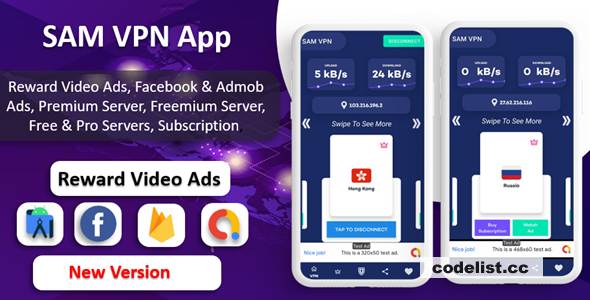
SAM VPN is very fast and secure VPN app and it’s have lot of secure servers in this VPN app when you can Swipe the Servers You can See more & more servers. In this VPN app you can connect any country server on only one click. we are using OneConnect Sdk. when you connect with any server you can in Swipe Effect. Now you can easily unblock those ego-restricted websites and gain access. In this app have Reward Video Ads For Unlock Premium Servers. You will get the Revenue By Subscription & Reward Video ads, Interstitial ads, Banner ads. We have Integrated Facebook and Admob Ads.
In an era when online privacy, access restrictions, and monetization strategies intersect, SAM VPN emerges as one of those app templates (or “kits”) that tries to balance user utility with developer revenue. Originally listed on CodeCanyon under the title “SAM VPN App – Secure VPN and Fast Servers VPN | Reward Video Ads | Subscription | Admob & FB Ads”, this offering promises a fast, secure VPN experience with built-in monetization mechanisms. CodeCanyon+2CodeCanyon+2
In this blog, we’ll unpack:
What SAM VPN claims to offer
How its monetization works
Pros, challenges and caveats
Use cases and target audience
Final thoughts & recommendations
Here’s a summary of the features and claims, based on the app listing:
So effectively, SAM VPN is a VPN app template that you can customize, brand, deploy, and monetize via ads + subscriptions.
One of the compelling reasons a developer might choose SAM VPN (or similar templates) is the built-in revenue pipelines. Let’s break that down.
Free users can access basic servers, but to unlock “premium” ones, they may need to watch video ads (rewarded ads).
This is a form of freemium monetization: users get a baseline free version, but access to better servers is gated.
Users who don’t want to watch ads can subscribe (monthly, yearly) to get direct access to premium servers without interruption.
Subscriptions tend to provide a more stable revenue source compared to ad-based models, especially for VPN services where users expect reliability.
For non-premium users, additional display or interstitial ads (via AdMob / Facebook) may be used to generate revenue on screens or during transitions.
Ad monetization is scalable and can work for many users who don’t convert to paid plans.
Subscriptions provide recurring revenue and better margins.
Reward ads offer a balance: non-paying users can still unlock parts of the premium service by watching ads — increasing engagement and ad impressions.
If you deploy a VPN app built from this template and scale user acquisition, even a modest percentage of conversions or ad engagement can make it viable.
Fast development path: Instead of building a VPN app from scratch, you get a boilerplate with logic, UIs, server switching, ad flows, etc.
Monetization baked in: You get the hooks for ads and subscriptions out of the box.
Flexible customization: You can rebrand, add your own servers, change UI flows, etc.
Security & trust: VPNs handle sensitive traffic. Using a template without deeply auditing code or backend servers can lead to leaks, weak encryption, or malicious behavior.
Server infrastructure costs: Running fast, secure VPN servers worldwide costs money (bandwidth, servers, maintenance). If your user base grows, the infrastructure cost may surpass ad/subscription revenues unless well balanced.
User experience friction: Forcing reward ads or gating servers might frustrate users and push them away.
App store / policy compliance: Google Play and Apple have strict policies around VPNs, user data privacy, and ad practices. You’ll need to ensure your implementation doesn’t violate them.
Competition: The VPN space is crowded, with many free / trustworthy options. Differentiation is hard.
Code quality / maintenance: Templates might have bugs or outdated dependencies. You’ll need to maintain updates yourself.
This kind of VPN template is most suited to:
App developers or small companies who want to launch a VPN product quickly without building everything from scratch.
Entrepreneurs aiming for passive income — if marketed well, ad/subscription mix can generate revenue.
Audience / region-based VPN services — e.g. targeting a specific country or niche (gamers, streaming fans, privacy-conscious users in restricted regions).
Prototyping and MVPs — you can test user demand before investing heavily in custom infrastructure.
It’s less ideal for:
Projects that demand extremely high security or advanced VPN features (e.g. multi-hop, custom protocols, zero-logging guarantees, enterprise applications).
Businesses that need full audit, regulatory compliance, or trust certification (unless you deeply vet the code and infrastructure).
SAM VPN is a solid example of how template-based development meets the modern app monetization ecosystem. If you consider using it (or a similar template), here are some practical tips:
Audit the code & security — ENSURE that encryption, DNS leak protection, and backend security are solid.
Choose server strategy carefully — maybe start with a few well-placed servers, monitor cost & usage, then scale.
Optimize monetization flows — test how many servers to gate vs how much free access to give. Too many gating = user frustration.
Respect privacy & policy — make sure you have a clear privacy policy, no invasive logging, and follow Play Store / App Store guidelines.
Brand and UX matter — don’t just ship the template as-is. Design, smooth animations, speed perception, customer support all play roles.
Measure & iterate — track user conversion, ad revenue, server load, churn — adapt pricing / gate strategies.
Demo: https://codecanyon.net/item/sam-vpn-app-secure-vpn-and-fast-servers-vpn-reward-video-ads-subscription-admob-fb-ads/30266325