

By 2026, the software development lifecycle (SDLC) will be fundamentally transformed by Artificial Intelligence. With predictions that 90% of code will be AI-generated and 84% of developers using AI tools, this article explores how AI is revolutionizing every phase, from planning and coding to testing and security, and reshaping the very role of the developer.
The world of software development is on the brink of its most significant transformation yet. The integration of Artificial Intelligence is no longer a futuristic concept—it's a present-day reality that is rapidly reshaping every facet of the Software Development Lifecycle (SDLC). By 2026, the way we design, build, test, and deploy software will be unrecognizable. This isn't about replacing developers; it's about augmenting their capabilities, supercharging productivity, and unlocking new levels of innovation. With a staggering 84% of developers already using or planning to use AI tools, the momentum is undeniable. Welcome to the new era of software development.

AI's role in the software development lifecycle begins long before a single line of code is written. In the planning and design phase, AI acts as an intelligent partner, helping teams validate ideas, analyze requirements, and even generate initial UI/UX mockups. AI algorithms can sift through vast amounts of market data, user feedback, and competitor analysis to identify potential features, predict user needs, and flag potential project risks. This data-driven approach minimizes guesswork and ensures that projects are aligned with real-world demands from the outset. Furthermore, AI tools can translate natural language project descriptions into structured user stories, technical specifications, and even preliminary architectural diagrams, dramatically accelerating the initial setup of a project.
By processing complex requirements, AI helps bridge the communication gap between stakeholders and development teams. It can create logical data models, suggest optimal technology stacks based on project goals, and ensure that all requirements are consistent and achievable. This leads to more accurate project timelines, better resource allocation, and a stronger foundation for the entire development process. The result is a planning phase that is faster, more accurate, and strategically sound.
The most dramatic impact of AI in the software development lifecycle is currently felt in the coding phase. AI coding assistants have evolved from simple autocompletion tools to sophisticated co-pilots capable of generating entire functions, classes, and algorithms based on a developer's natural language prompts. With experts predicting that 90% of code will be AI-generated in 2026, the act of writing code is fundamentally changing. Developers are transitioning from being manual code writers to being orchestrators of AI tools. This shift allows them to focus on the more complex, creative, and architectural aspects of software engineering.
This new dynamic has given rise to a trend known as "vibe engineering." This is where AI moves beyond generating small, isolated snippets of code to delivering comprehensive, engineering-grade outputs based on high-level developer intent or 'vibe'. A developer might describe the desired functionality, the user experience, and the architectural constraints, and the AI will generate a robust, multi-faceted solution that fits the description. This paradigm shift is empowering developers to build more complex applications faster than ever before. It's not about losing control; it's about leveraging a powerful tool to translate a creative vision into functional code with unprecedented speed and efficiency.

AI-powered testing and Quality Assurance (QA) are making the process of finding and fixing bugs faster and more reliable than ever. AI tools can automatically generate comprehensive test cases directly from project specifications, ensuring complete coverage and eliminating human error. They can analyze code changes and intelligently predict which areas of an application are most at risk for new bugs, allowing QA teams to focus their efforts where they are needed most. During testing, AI can perform exploratory testing by mimicking user behavior, uncovering edge cases and usability issues that scripted tests might miss. It can also automate visual regression testing, instantly spotting unintended UI changes that could negatively impact the user experience. This level of automation significantly accelerates release cycles while simultaneously improving the quality and stability of the final product.
With AI handling much of the repetitive and time-consuming tasks, what does the future hold for developers? The role is not disappearing; it's evolving into something more strategic. A forecast indicates that 75% of developers will soon spend more time on orchestration and high-level architecture. Instead of writing boilerplate code, they will be designing systems, making critical architectural decisions, and guiding AI tools to build out the components. The modern developer is becoming a systems thinker, a problem solver, and a technology strategist. Skills like prompt engineering, AI model integration, and understanding the ethical implications of AI are becoming just as important as traditional coding languages. This is an exciting evolution that elevates the developer's role to one of greater impact and creativity.
Two major trends highlight the future trajectory of AI in software development: on-device AI and the rise of AI-first startups. On-device AI involves running AI models directly on user devices like smartphones and laptops, rather than in the cloud. This approach offers significant advantages, including the ability to reduce latency by up to 80% and enhance data privacy by keeping sensitive information local. This is critical for applications requiring real-time responsiveness, such as augmented reality and intelligent personal assistants. Concurrently, we are seeing the emergence of "AI-first" startups. These nimble companies are built from the ground up to leverage AI in every aspect of their operations. This allows incredibly small teams, often just 3-5 developers, to achieve the productivity and output of a much larger, traditional engineering team. They can build, test, and iterate on complex products at a speed that was previously unimaginable, disrupting industries and setting new standards for efficiency.
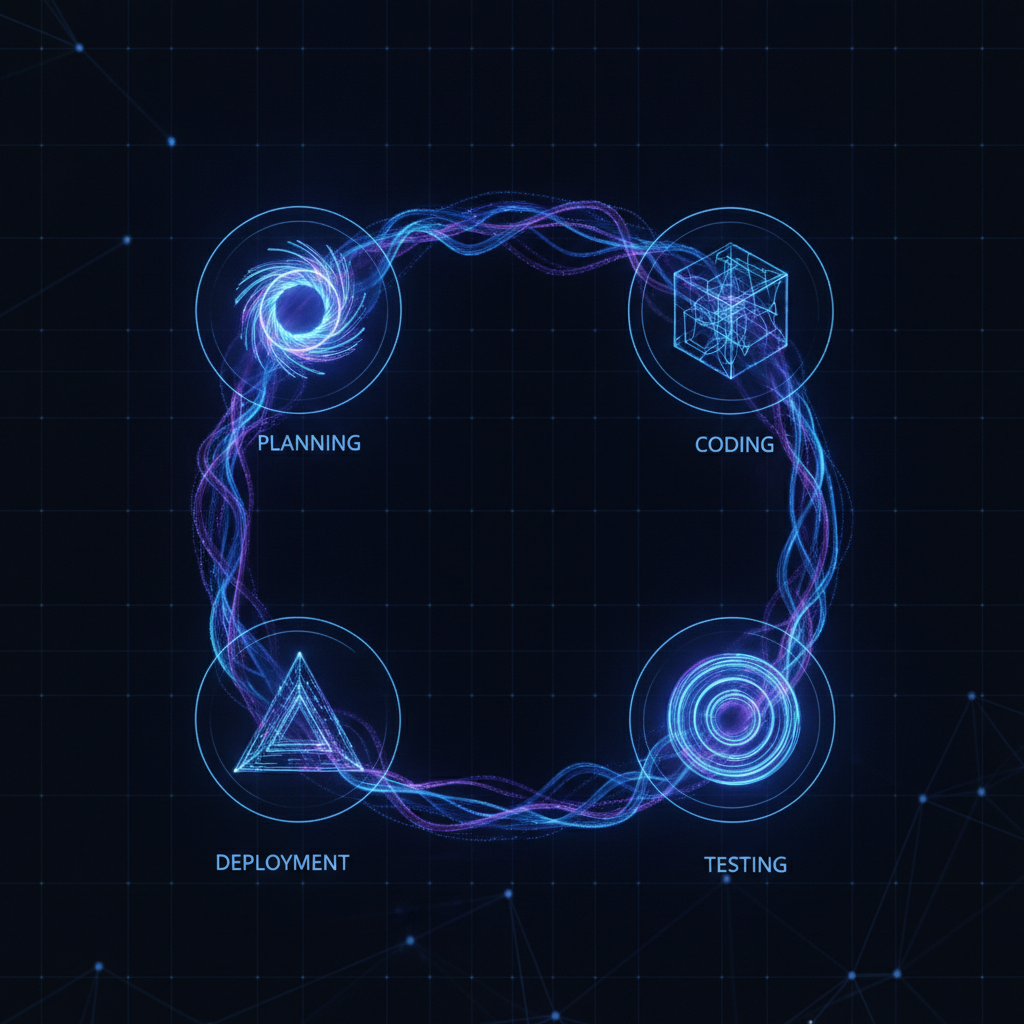
AI in the software development lifecycle (SDLC) refers to the integration of artificial intelligence tools and technologies across all phases of software creation, including planning, design, coding, testing, deployment, and maintenance, to automate tasks, improve efficiency, and enhance quality.
No, AI is not expected to replace software developers. Instead, it is augmenting their abilities and shifting their role. With forecasts suggesting 75% of developers will focus more on architecture and orchestration, AI is becoming a powerful co-pilot that handles repetitive coding, allowing humans to focus on strategic thinking, creativity, and complex problem-solving.
'Vibe engineering' is an emerging trend where developers provide high-level, intent-based prompts or descriptions (the 'vibe') to an AI system, which then generates comprehensive, engineering-grade code and solutions. It represents a shift from generating small code snippets to creating complete, functional components based on a developer's vision.
On-device AI processes data locally on a user's device rather than sending it to the cloud. This significantly improves application performance by reducing latency by up to 80% and enhances user privacy and security by keeping sensitive data from leaving the device.